
Australia Student Visa (Subclass 500) 2026: The Complete Subclass 500 Guide for Pakistani Students
GTE is gone, fees rose to AUD 2,000, and Pakistan is Evidence Level 3. Everything Pakistani students need for the Australia Subclass 500 visa in 2026.
A student from Faisalabad contacted our office after receiving a refusal on her Australian student visa application. Her documents were complete, her financials were solid, and her university — a CRICOS-registered institution in Melbourne — was reputable. The refusal came down to one line in her application: a Genuine Temporary Entrant (GTE) statement that her previous consultant had helped her write. The GTE was abolished in March 2024. The application had been prepared using a template that was over two years out of date.
Australia remains one of the most achievable and rewarding study destinations for Pakistani students — HHC holds a 98% success rate on Australian applications. But that success depends entirely on understanding the current rules, not the ones from 2022 or 2023. This guide covers every material change that has taken effect since 2024, what Pakistani applicants at Evidence Level 3 must prepare, how to write a Genuine Student statement that a DHA case officer will accept, and what the total cost of an Australian student visa application actually looks like in rupees.
WHAT PAKISTANI APPLICANTS ARE STILL GETTING WRONG IN 2026
MYTH: “I need to write a GTE (Genuine Temporary Entrant) statement.”
FACT: The GTE test was replaced by the Genuine Student (GS) requirement from March 23, 2024. The GS is a structured questionnaire within the ImmiAccount application form — four specific questions, each with a maximum 150-word response. Long narrative GTE statements no longer exist in the application. Any consultant preparing a GTE statement in 2026 is working from an abolished framework. Source: DHA, effective March 2024.
MYTH: “The visa fee is AUD 1,600.”
FACT: The base application fee for the Subclass 500 Student Visa increased to AUD 2,000 from July 1, 2025 — a 25% increase. At 1 AUD » PKR 200 (2026), this equals approximately PKR 400,000. The old AUD 1,600 figure is no longer applicable. Source: studyaustralia.gov.au, effective July 1, 2025.
MYTH: “I only need 3 months of bank statements.”
FACT: DHA now expects 3 to 6 months of consistent bank statement history for Pakistani applicants at Evidence Level 3. A single large deposit made shortly before applying is a standard red flag. The statement must show the funds building or remaining stable over multiple months — not appearing suddenly. Source: DHA financial evidence guidance.
MYTH: “OSHC can be arranged after my visa is granted.”
FACT: Overseas Student Health Cover (OSHC) is mandatory and must be purchased and attached to the visa application before it is submitted. An application submitted without OSHC confirmation will be refused at the validity stage. Your institution or a registered OSHC provider issues the confirmation; keep the policy number ready. Source: studyaustralia.gov.au.
Pakistan at Evidence Level 3: What This Means for Your Application
The Department of Home Affairs classifies all countries applying for Australian student visas into Evidence Levels — a risk-based framework that determines the depth of documentation required. In 2026, Pakistan is classified as Evidence Level 3.
| Evidence Level | Risk Classification | What It Means for Applicants |
|---|---|---|
| Level 1 | Low risk | Streamlined document requirements; faster processing typical |
| Level 2 | Medium risk | Standard documentation required; financial evidence necessary |
| Level 3 - Pakistan | High scrutiny | Full financial evidence, 6 - 12 month bank history, thorough GS responses, potential for additional checks |
Being classified as Evidence Level 3 does not disqualify a Pakistani student — it means the application must be more thorough, more consistent, and more clearly documented than applications from lower-risk countries. A well-prepared Level 3 application from Pakistan succeeds. A hasty or incomplete one will not.
What the Subclass 500 Visa Actually Costs in 2026
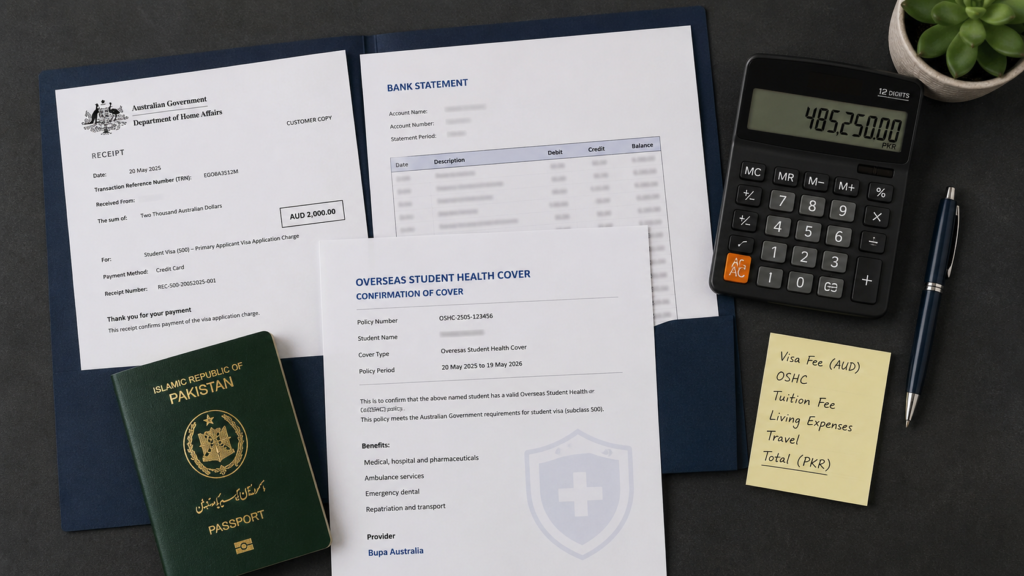
The visa application fee is one of several mandatory costs. Pakistani families must budget for the full picture before the application is submitted.
| Cost Item | Amount (AUD) | Approx. PKR (2026) | Notes |
|---|---|---|---|
| Visa application fee (primary applicant) | AUD 2,000 | ~ PKR 400,000 | Increased from AUD 1,600 on July 1, 2025. Non-refundable. Pay via ImmiAccount. |
| Visa fee — spouse dependant (if included) | AUD 2,000 | ~ PKR 400,000 | Each adult dependant pays the same fee as the primary applicant. |
| Financial proof — living costs (12 months) | AUD 29,710 | ~ PKR 5.94 million | Mandatory minimum. Separate from tuition and travel. |
| First-year tuition (typical undergrad range) | AUD 20,000–38,000 | ~ PKR 4–7.6 million | Confirm exact amount on your CoE. Must be shown alongside living costs. |
| Return airfare estimate | ~ AUD 2,000 | ~ PKR 400,000 | DHA requires evidence of funds for return travel. |
| OSHC — health cover (approx. per year) | AUD 500–700 | ~ PKR 100,000–140,000 | Mandatory. Must be purchased before lodging application. |
| Medical examination | Varies | ~ PKR 20,000–25,000 | DHA-approved panel physicians in Lahore, Islamabad, Karachi. |
| Biometrics (if required) | Varies | ~ PKR 10,000–12,000 | May be required depending on applicant profile. |
The Genuine Student (GS) Requirement: What It Is and How to Answer It
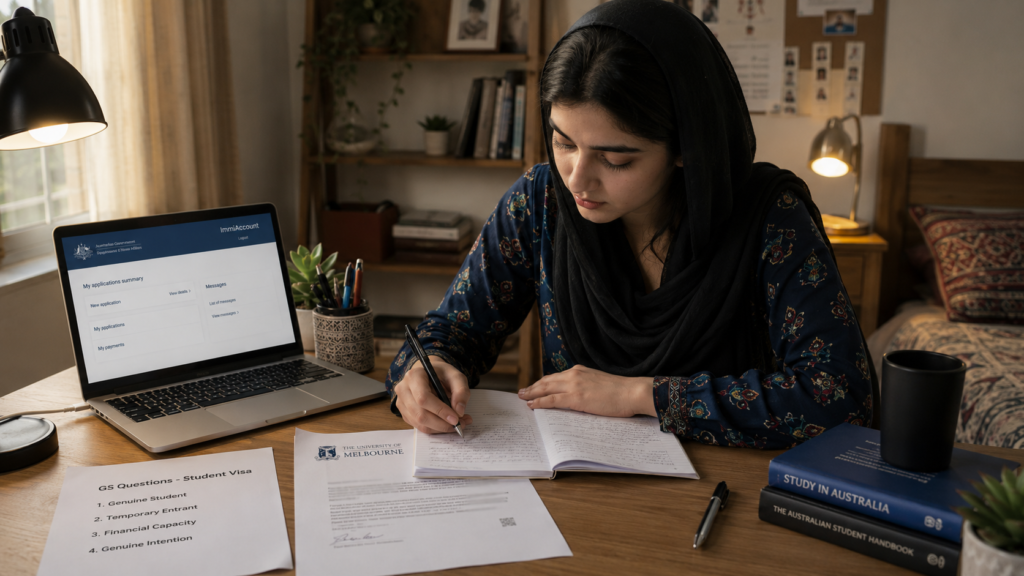
The GS requirement replaced the old GTE (Genuine Temporary Entrant) statement from March 23, 2024. Unlike the old GTE — which was a long free-form personal statement — the GS consists of four structured questions within the ImmiAccount online application form. Each answer has a maximum of 150 words.
Pakistani applicants at Evidence Level 3 must take the GS seriously. DHA case officers in 2025–2026 are paying close attention to the specificity, consistency, and logical coherence of GS responses. Generic, copied, or vague answers — particularly answers sourced from online templates — are among the top refusal triggers for Pakistani applications.
| The 4 Genuine Student (GS) Questions — max 150 words each |
|---|
| Q1: What are your current circumstances — including ties to family, community, and employment? What DHA looks for: Specific ties to Pakistan: family responsibilities, property ownership, employment, community obligations. Avoid vague generalities. State concrete facts: "I manage my father's textile business in Faisalabad, which I intend to expand using skills from my Australian programme." |
| Q2: Why have you chosen this specific course and institution? What DHA looks for: Concrete reasons that connect to your prior education and career goals. Name the institution. Explain why Australia specifically — accreditation, research output, industry links. The more specific to your actual circumstance, the stronger. |
| Q3: How will the course you have chosen benefit your future? What DHA looks for: The career-return-on-investment argument: how does this qualification open specific opportunities in Pakistan or your home region? Name industries, roles, or businesses that your qualification will prepare you for. Quantify where possible. |
| Q4: Is there any other information you would like to provide? What DHA looks for: Use this to address anything that might raise questions: any gap in education, a course field change, prior visa applications, or unusual financial circumstances. Proactively addressing potential concerns is far better than leaving them unanswered. |
The Subclass 500 Application: Step by Step
1: Get Accepted by a CRICOS-Registered Institution
Your institution must be registered on the Commonwealth Register of Institutions and Courses for Overseas Students (CRICOS). Before accepting any offer or paying any deposit, verify the institution’s CRICOS registration on the DHA website (cricos.teqsa.gov.au). Some private colleges lose registration without warning — studying at a non-CRICOS institution invalidates your visa.
Once admitted, accept your offer and receive your Confirmation of Enrolment (CoE) — an electronic document from PRISMS (the national enrolment records system). Your CoE contains a unique number required for the visa application. Make sure your course has no gaps between components longer than 2 calendar months.
2: Purchase OSHC Before Applying
Overseas Student Health Cover (OSHC) is mandatory for the entire duration of your visa — not just your course. You must purchase OSHC from an approved provider and have your policy number or confirmation certificate ready before lodging the visa application in ImmiAccount.
OSHC providers approved for Pakistan-based students include: Allianz Care, BUPA Australia, Medibank, nib OSHC, and Peoplecare Health. Approximate cost: AUD 500–700 per year (» PKR 100,000–140,000). For a 3-year bachelor’s degree, budget AUD 1,500–2,100 total.
3: Build Your 6 – 12 Month Financial Evidence
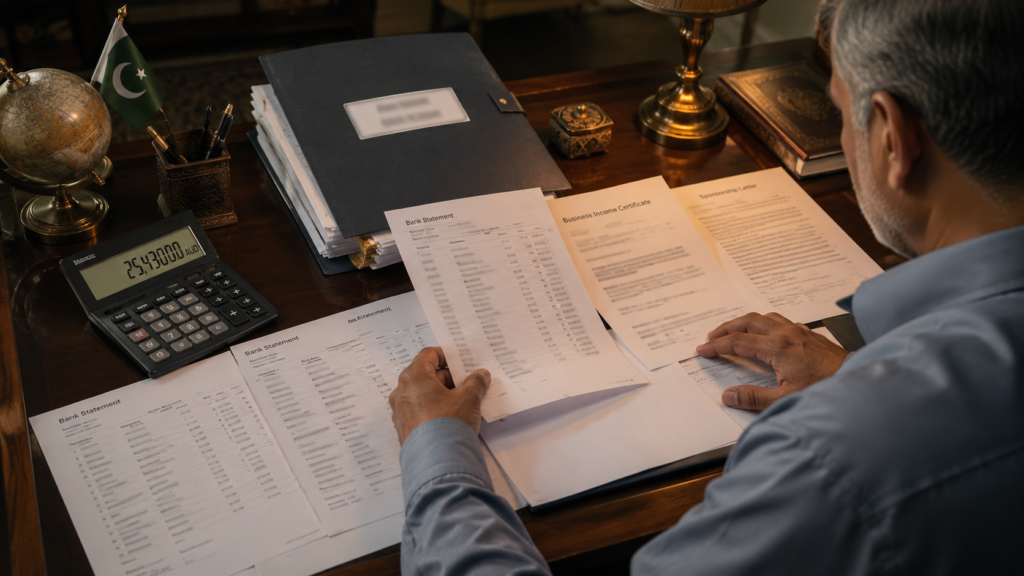
Pakistan’s Evidence Level 3 classification means DHA will scrutinise your financial evidence more carefully than average. Do not start building this evidence 30 days before applying — start 2 – 3 months in advance.
Required financial evidence:
• Minimum AUD 29,710 for 12 months of living costs (studyaustralia.gov.au)
• Full first-year tuition as shown on your CoE
• Approximately AUD 2,000 for return travel
• Bank statements showing 6 – 12 months of consistent history
• Source-of-funds evidence: salary slips, business income, rental deeds, fixed deposits, or education loan
documentation
• If a sponsor is funding the application: their full financial documentation plus a signed sponsorship letter
explaining the relationship
4: Complete a Medical Examination (if Required)
DHA requires Pakistani applicants to undergo a medical examination with an approved panel physician. This includes a chest X-ray and general health assessment. DHA-approved panel physicians operate in Lahore, Islamabad, and Karachi — use the DHA Panel Physician Locator at immi.homeaffairs.gov.au to find the current approved clinics.
Results are submitted directly to DHA by the clinic — not by you. The health check is valid for 12 months. Schedule it early to avoid delays.
5: Lodge Your Application via ImmiAccount
Submit the Subclass 500 application online at immi.homeaffairs.gov.au/ols/. You will need: your CoE number, OSHC policy confirmation, passport, financial evidence, academic transcripts, English test results, and your four GS responses. Fees payable at this stage: AUD 2,000 visa application fee (non-refundable). Pay by credit or debit card. Keep your Transaction Reference Number as proof.
Critical: Do not hide any immigration history — refused visas, expired visa overstays, or prior Australian visa grants. DHA has access to your full immigration record. Omissions are treated as misrepresentation.
6: Await Decision
Standard processing for offshore Pakistani applicants: 4–12 weeks. Processing is influenced by application completeness, your institution’s priority status under DHA’s National Planning Level (NPL) framework, and whether medical or character checks are required.
The National Planning Level cap for 2026 is 295,000 student visa places. Priority 1 institutions (high-ranking universities with strong compliance records) have their students processed first. If your institution is lower-priority, processing may be delayed — especially for the July intake period.
Why Australian Student Visa Applications from Pakistan Get Refused
The following refusal patterns appear repeatedly in DHA decisions involving Pakistani applicants in 2025–2026.
1. Vague or Template-Copied GS Responses
DHA case officers readily identify GS responses that have been copied from online templates or generated by AI tools. Responses that don’t reference specific personal circumstances, the specific course, or the specific institution are treated with significant scepticism. Each answer must be uniquely and specifically yours.
2. Insufficient Financial Evidence or Suspicious Fund History
Funds that appear suddenly in a bank account one month before the application — without corresponding income history — are a primary refusal trigger for Evidence Level 3 applicants. DHA in 2026 is cross-checking deposit patterns against claimed income sources. The financial story must be verifiable end-to-end.
3. Course Does Not Logically Progress from Prior Education
A student with an FSc in pre-medical applying for a bachelor’s in IT without any explanation of the shift will raise questions. DHA looks for logical academic progression. If you are changing fields, the GS response must clearly articulate a compelling and documented rationale.
4. OSHC Not Attached at Time of Lodgement
The OSHC policy confirmation must be included when the application is submitted via ImmiAccount — not uploaded later. Applications missing OSHC are refused at the validity check without being assessed on merit.
5. Non-CRICOS Institution
Private colleges operating without CRICOS registration frequently target Pakistani students with attractive offers and low entry requirements. Studying at such an institution is illegal on a student visa. Verify CRICOS status before accepting any offer — not after paying tuition.
6. Undisclosed Prior Immigration Issues
Any previously refused visa to Australia or any other country must be disclosed. Prior student visa conditions (attendance, work hours, enrolment requirements) that were breached must also be disclosed. DHA’s data systems flag undisclosed issues as misrepresentation — an outcome far more serious than the original issue.
At Hoist Horizons Consultancy, the GS questionnaire is the stage where we invest the most preparation time with our Australian applicants — because it is the stage most Pakistani consultancies handle casually. A GS response that reads like a template, or that mentions a family business without attaching a registration certificate, gives DHA a reason to doubt everything else in the file. We have maintained a 98% success rate on Australian visa applications precisely because we treat every GS response as a case-specific argument, not a form to fill.
FAQ
Is the GTE statement still required for Australian student visa?
No. The GTE (Genuine Temporary Entrant) statement was abolished from March 23, 2024. It has been replaced by the Genuine Student (GS) requirement — four structured questions in the ImmiAccount application form, each with a maximum 150-word response. Any consultant still preparing a GTE statement in 2026 is working from an outdated framework that no longer exists in the DHA application system.
How much money do I need to show for an Australian student visa in 2026?
The minimum living cost requirement confirmed by studyaustralia.gov.au is AUD 29,710 for 12 months. This must be shown separately from your first-year tuition (as stated on your CoE) and an estimated AUD 2,000 for return travel. Total financial proof typically ranges from AUD 52,000–70,000 (» PKR 10.4–14 million) for a standard undergraduate programme. Funds must show 3–6 months of consistent, verifiable history.
What is the current Australia student visa fee from Pakistan?
AUD 2,000 per application for the primary applicant, effective from July 1, 2025 (increased from AUD 1,600). At 1 AUD » PKR 200 (May 2026), this is approximately PKR 400,000. The fee is non-refundable even if the application is refused. Source: studyaustralia.gov.au.
What is Evidence Level 3 and does it affect my chances?
Evidence Level 3 is DHA’s classification for countries requiring heightened document scrutiny. Pakistan is currently at Level 3, meaning DHA case officers expect more detailed financial documentation, a longer bank statement history, and more specific GS responses. It does not disqualify Pakistani applicants — well-prepared Level 3 applications are regularly approved. It does mean incomplete or vague applications face a much higher refusal risk than lower-level-country applicants.
Can I work while studying in Australia on a student visa?
Student visa holders may work up to 20 hours per week during term time and unlimited hours during official university breaks (semester holidays). Work must comply with visa conditions — breaching work hour limits is grounds for visa cancellation.
What is OSHC and when must I buy it?
Overseas Student Health Cover (OSHC) is mandatory health insurance for international students in Australia. You must purchase OSHC for your entire visa duration before submitting your application via ImmiAccount. Cost: approximately AUD 500–700 per year. Providers include Allianz Care, BUPA, Medibank, nib OSHC, and Peoplecare. A visa application submitted without OSHC confirmation is invalid and will be refused.
The Subclass 500 Application: Step by Step
Australia is one of the most achievable destinations for Pakistani students who prepare properly. The 98% success rate HHC maintains on Australian applications is not the result of luck or connections — it comes from treating every element of the application as evidence that must tell a coherent, documentable story.
Three things matter most. First: your Genuine Student responses must be specific to you — your circumstances, your institution, your career case — not copied from any template. Second: financial evidence must show 6 – 12 months of consistent history with a verifiable source, not a balance that appears three weeks before submission. Third: OSHC must be purchased before the application is lodged — it is not optional and cannot be added after submission.
Ready to Start Your Study Abroad Journey?
Book your free 30-minute consultation today. We’ll assess your profile, recommend the best countries, and create a personalized plan. No pressure, no commitments.
- +92 339 8255 442
- hello@hoisthorizons.com
- Khayaban-e-Amin, Lahore, Pakistan