
Fully Funded vs Merit-Based Scholarships
Learn the real difference between fully funded and merit-based scholarships, what Pakistani students often misunderstand, and what support Hoist Horizons Consultancy actually offers.
The Difference Pakistani Families Must Understand
“Scholarship chahiye” is one of the first things many Pakistani students say in a consultation. That is understandable. Exchange rates are brutal, international tuition is high, and families want relief wherever they can find it. The problem begins when all scholarships are treated as if they are the same thing.
They are not.
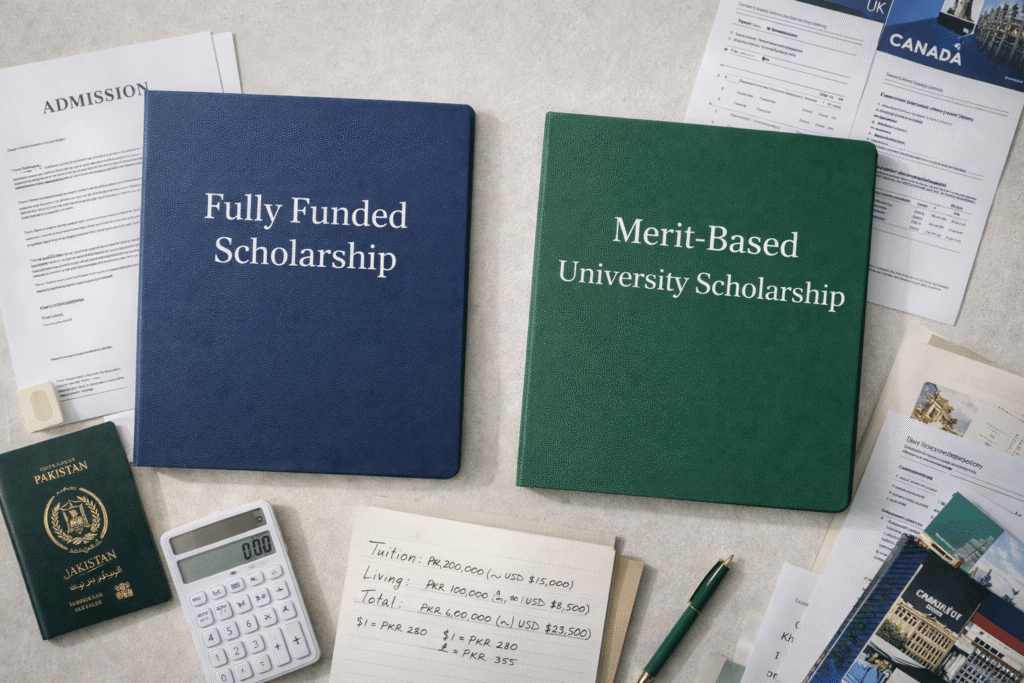
Why scholarship confusion is so common in Pakistan
One of the most damaging planning mistakes in study abroad is confusing a fully funded scholarship with a merit-based university award. The two can look similar in casual marketing language, but in practice they are completely different in competitiveness, process, coverage, timelines, and probability.
What a fully funded scholarship actually means
A fully funded scholarship usually means a highly competitive external or flagship award that covers most or all major costs, often including tuition and at least some combination of living expenses, travel, visa, or insurance support. Think of programs like Chevening for the UK, Erasmus Mundus Joint Masters in Europe, or the Fulbright degree route managed in Pakistan through USEFP. These programs are real, prestigious, and life-changing. They are also highly selective, usually separate from standard university admission processing, and often demand a stronger profile, tighter timelines, more essays, stronger recommendations, and sometimes professional or leadership evidence as well.
What a merit-based university scholarship usually means
A merit-based scholarship is different. In many cases it is linked directly to the university or to a specific program. It may be awarded automatically after admission review, or it may require a separate but much lighter institutional application. Merit scholarships often reduce tuition, but they usually do not cover the full cost of studying and living abroad. They are still valuable. In fact, for many Pakistani families, they are the more practical target because they are closer to the normal admission process and easier to build into a realistic financial plan. But they should not be described as “fully funded” unless they truly cover that level of cost.
Why most students should build an admission-first budget plan
This distinction matters because it changes how families should plan. If a student builds the entire dream around a fully funded outcome that never arrives, the whole plan can collapse. This happens often. Families hear “scholarship available” and assume their burden will reduce dramatically, only to discover later that the award is partial, competitive, or not offered to their program at all. By then, time has been lost, expectations have hardened, and trust is damaged.
A more responsible approach is admission-first budgeting. That means the family first asks: If no major scholarship comes through, can we still sustain the route? If the answer is no, then the student either needs a more affordable country list, a lower-cost institutional shortlist, a different level of study, or a longer preparation timeline. Merit scholarships should improve the plan, not rescue a weak plan that never made financial sense in the first place.
Common scholarship myths that waste time and money
Pakistani students also need to understand the profile difference between the two categories.
Fully funded routes often reward far more than grades. They may look for leadership, clarity of purpose, national impact, research strength, social commitment, or a mature story about why the degree matters. Some also come with return-home expectations or specific policy objectives. Merit-based university scholarships, on the other hand, are often more tightly connected to the applicant’s
academic record, personal statement quality, overall fit, and how competitive the university sees the file against its broader international pool.
Another common mistake is choosing a country or course based on the word “scholarship” rather than on actual fit. A student who chooses the wrong program simply because it appears to offer funding may end up with a weak visa case, poor employability, or a degree that does not match long-term goals. A smaller but better-fit merit award at the right university can be far more useful than chasing a glamorous scholarship label attached to the wrong route.
Families should also be careful with consultant language. Phrases like “100% scholarship guarantee,” “fully funded seat available,” or “scholarship assured after offer letter” should immediately raise concern unless the consultant is referring to a specific published award and can explain the official criteria clearly. Real scholarship guidance is detailed. It explains award type, who grants it, whether it is automatic or competitive, what it covers, whether it renews, and what the student still needs to pay.
How to plan ethically and realistically
So what should a realistic scholarship plan look like for Pakistani students?
First, separate scholarships into categories: fully funded external, major university-funded competitive awards, and normal merit discounts or tuition waivers. Second, plan the base budget without assuming a miracle. Third, build the application file as strongly as possible because even merit awards often depend on a sharper statement, better program fit, cleaner documents, and better timing. Fourth, understand that scholarship timelines can be earlier than admission deadlines. Fifth, verify every claim from an official university or program page.
In other words, the right question is not “Can I get a scholarship?” The right question is “What kind of scholarship is realistic for my profile, and does my plan still work if the award is partial?” Families who ask that question make stronger, calmer, and more financially intelligent decisions.
Scholarships are part of strategy, not a substitute for strategy. The earlier Pakistani students understand that, the safer and smarter their study-abroad planning becomes.
What Hoist Horizons Consultancy actually helps with
This is also why Hoist Horizons Consultancy’s scholarship positioning should stay clear and disciplined. HHC publicly states that it helps with university automatic and merit-based scholarships, not external fully funded scholarships as a standard service. That is the correct and ethical position. It keeps the consultancy aligned with realistic admissions work rather than feeding a fantasy market. For serious families, this is actually a trust signal. It tells them HHC is not trying to win a lead by promising something it does not normally process.
This is where HHC can add practical value. A serious consultancy can help identify scholarship-friendly universities within the approved destination list, strengthen admission documents, and improve the student’s positioning for university-linked merit opportunities. That is very different from pretending every student is one SOP away from a fully funded dream.
FAQ
What is the main difference between a fully funded scholarship and a merit-based scholarship?
A fully funded scholarship usually covers most or all major study costs and is highly competitive. A merit-based scholarship is usually a partial tuition reduction or university-linked award connected more closely to the admission process.
Does Hoist Horizons Consultancy help with fully funded scholarships?
Not as a standard service. HHC’s public positioning is focused on university-based merit scholarships and admission-linked scholarship opportunities rather than fully funded scholarship processing as a normal package.
Can merit scholarships still make a big difference?
Yes. Even partial tuition relief can improve affordability significantly, especially when it is combined with smart university selection and a realistic country strategy.
Should I apply only to universities that mention scholarships?
No. You should first choose universities that fit your academic profile, budget, and long-term goals. Scholarship potential should support the choice, not distort it.
Are scholarships guaranteed if my grades are good?
No. Strong grades help, but scholarships also depend on institutional priorities, competition, timing, program fit, and application quality.
Ready to Start Your Study Abroad Journey?
Ask Hoist Horizons Consultancy to build an admission-first shortlist that includes realistic university merit-scholarship opportunities without misrepresenting fully funded routes.
- +92 339 8255 442
- hello@hoisthorizons.com
- Khayaban-e-Amin, Lahore, Pakistan